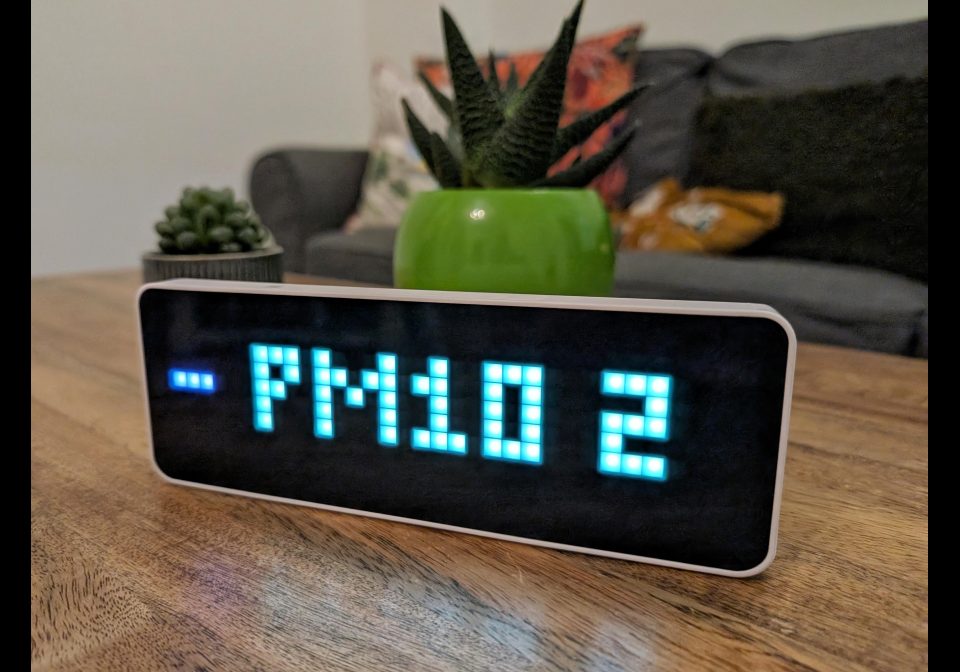
Air Quality Index from specific site in London
Scrolls through all valid measurements reported by specific site.
| System | AWTRIX NG Scripts |
|---|---|
| Firmware | AWTRIX NG |
| Topic | Smarthome |
| Built by | kowalcj0 |
| File | 5Tw5xjVl6v96.ax · 6.9 KB |
| Icons | — |
| Published | 2 Sep 2026 · updated 2 Sep 2026 |
| Downloads | 1 |
You only need to set the Site Code (e.g. BT8) in the app settings. To find it: open the London Air index page, find the site on the map, click View monitoring data, and take the value of the site parameter from the resulting URL.
FYI: Script will then fetch the Air Quality data from this API endpoint:
http://api.erg.ic.ac.uk/AirQuality/Hourly/MonitoringIndex/SiteCode=<SITE_CODE>/Json
It uses http instead of https to save on resources.
5Tw5xjVl6v96.ax
# @name    London Air Quality
# @desc    Show per-pollutant Air Quality Index (NO2, O3, PM1, PM2.5, PM10, CO, SO2, NO - whichever the site reports) for a specific location in London, each reading tinted by its London Air band colour. Data feeds comes from Environmental Research Group (ERGP) at Imperial College London. More details on https://www.londonair.org.uk/Londonair/API/ and API documentation https://api.erg.ic.ac.uk/airquality/help
# @author  kowalcj0
# @version 1.2
# @config  site_code  text    "Site Code"  default="BT8"  help="site code, e.g. BT6"
# @config  every  number  "Refresh"  default=30 min=5 max=120 unit=min

import gc

class AirQuality
  # London Air index values 1-10 -> colour, see
  # https://www.londonair.org.uk/london/asp/airpollutionindex.asp
  var levels, url, label, color, opts, err
  # refresh countdown + failure backoff, see due()/failed()/ok()/now()
  var ticks, interval, retry, busy

  def init()
    self.levels = [
      0xADD189, 0x77AD53, 0x2E8405,  # 1-3 low
      0xEFC192, 0xFE9C53, 0xF46200,  # 4-6 moderate
      0xDC1B1B, 0xA70B0B, 0x7B0000,  # 7-9 high
      0xFFFFFF,                      # 10 very high (official black is invisible on the panel)
    ]
    # saving a setting restarts the app, so the URL built here never goes
    # stale. Plain HTTP on purpose: a TLS handshake needs ~45 KB contiguous
    # heap, which this ESP32 can't spare (attempts OOM-panic the device);
    # the ERG API also serves unencrypted, and the payload is public data
    self.url = ""
    var site_code = store.get("site_code")
    if site_code != nil && site_code != ""
      self.url = "http://api.erg.ic.ac.uk/AirQuality/Hourly/MonitoringIndex/SiteCode=" + str(site_code) + "/Json"
    end
    # refresh interval in minutes (hourly feed; keep requests few)
    self.interval = clamp(num(store.get("every"), 0), 5, 120) * 60
    # label is a list of [text, colour] pieces, one per reading; plain
    # string ("--" / "?") until the first successful fetch
    self.label = nil
    self.color = 0x666666
    # marquee over the whole panel; built once, passed every frame
    self.opts = {'mode': "loop", 'speed': 100}
    self.ticks = 0
    self.retry = 30
    self.busy = false
    self.err = false
  end

  # first fetch + fill display state before the first frame
  def setup()
    log("London Air: " + str(gc.allocated()) + " B live in the Berry heap")
    self.loop()
  end

  # select forces a refresh; left and right just rotate
  def on_button(btn)
    if btn == "select"
      self.now()
    end
  end

  def on_body(body, status)
    shared.set("f", 0)
    # non-200 or nil body: nothing usable this attempt
    if status != 200 || body == nil
      log("London Air: fetch failed, status " + str(status))
      self.failed()
      return
    end
    # the find/keep window holds the species list only; the site reports
    # one index per pollutant and which species a site has varies, so every
    # known code is probed, in health-impact order: NO2 nitrogen dioxide,
    # O3 ozone, PM1/PM25/PM10 particulate, CO carbon monoxide, SO2 sulphur
    # dioxide, NO nitric oxide. Each is shown with its own London Air band
    # colour. (A full json.load() of the body would build a tree of ~30
    # small maps/strings per fetch and fragment the tight ESP32 heap.)
    var pieces = []
    for code : ["NO2", "O3", "PM1", "PM25", "PM10", "CO", "SO2", "NO"]
      var pat = "\"@SpeciesCode\":\\s*\"" + code + "\"\\s*,\\s*\"@AirQualityIndex\":\\s*\"(\\d+)\",\\s*\"@AirQualityBand\":\\s*\"([^\"]+)\""
      var m = re.search(pat, body)
      var n = nil
      var band = nil
      if m != nil
        n = num(m[1])
        band = m[2]
      end
      if n != nil && n > 0 && band != nil && band != "No data"
        # display name: PM25 -> "PM2.5"
        var name = (code == "PM25" ? "PM2.5" : code)
        if size(pieces) > 0
          pieces.push([" - ", 0x888888])
        end
        # "NO2 3", tinted by this pollutant's London Air band
        pieces.push([name + " " + str(n), self.band_color(n)])
      end
    end
    if size(pieces) == 0
      log("London Air: no readings in window")
      self.failed()
      return
    end
    self.label = pieces
    self.ticks = self.interval
    self.ok()
    log("London Air: ok, " + str(int(size(pieces) / 2)) + " readings")
  end

  # London Air band colour for a reading (1-10); clamps out-of-range values
  def band_color(n)
    n = int(n)
    if n < 1
      n = 1
    elif n > 10
      n = 10
    end
    return self.levels[n - 1]
  end

  def loop()
    # url checked first: due() raises busy as a side effect
    if self.url != "" && self.due()
      shared.set("f", 1)
      # stream-skip everything before the species list: only a 1 KB window
      # lands on the heap, not the full ~1.4 KB body. 1024 B covers the
      # largest response seen so far (4 species); if a site ever reports
      # more, the tail entries simply don't match and are not shown
      http.get(self.url, / b, st -> self.on_body(b, st), {'find': '"species"', 'keep': 1024})
    end

    # until the first successful fetch: show "--", or "?" once a fetch has
    # failed (see failed())
    if self.label == nil
      self.label = self.err ? "?" : "--"
      self.color = self.err ? 0xCC7722 : 0x666666
    end
  end

  # Fires when the countdown has run down, never while a request is out or
  # another app's TLS handshake is running (shared "f" flag, official
  # convention). Raises busy, so only call it when a request will actually
  # be issued. The countdown is armed by the fetch result (interval on
  # success, backoff on failure).
  def due()
    if self.ticks > 0
      self.ticks = self.ticks - 1
      return false
    end
    if self.busy
      return false
    end
    for k : shared.keys()
      var n = size(k)
      if n > 2 && k[n - 2 .. n - 1] == ".f" && shared.get(k) == 1
        var a = shared.age(k)
        if a != nil && a < 20000
          return false
        end
      end
    end
    # floor: even if the callback never came, the next try is a minute away
    self.ticks = 60
    self.busy = true
    return true
  end

  # failure backoff: retry at 30s, doubling, capped at 5 min; raises err so
  # a fetch with no data yet can show "?" instead of "--"
  def failed()
    self.busy = false
    self.ticks = self.retry
    self.retry = min(self.retry * 2, 300)
    self.err = true
  end

  def ok()
    self.busy = false
    self.retry = 30
    self.err = false
  end

  # manual refresh: clears the countdown but leaves busy alone, so a press
  # while a request is out can't fire a second one
  def now()
    self.ticks = 0
    self.retry = 30
  end

  def draw()
    clear()
    # each reading piece carries its own band colour; the plain "--"/"?"
    # fallback uses the call colour
    scroll_text(0, 6, width(), self.label, self.color, self.opts)
  end
end

return AirQuality()
Install it on your AWTRIX NG
Your browser writes the script straight to the device on your network. It joins the app rotation right away.
Some browsers refuse to talk to a device on your network from a public page. Download the flow and paste it into the Scripts tab of your device, or install it from a terminal:
More flows for AWTRIX NG Scripts or Smarthome
Something wrong with this flow? Report it.